Recent Activity in the Village
-
-
If a year has passed and there has been no progress toward goals, it's one of a few things. (1) The haven't really identified the disability and the intervention isn't a good match to the issue. Additional testing would be needed if this was the issue. (2) They did a good eval but the intervention isn't a good match. Might be due to untrained teacher trying to something they don't know how to do. Might be a program that doesn't address the real issue. Could also be a bit of both. (I know a young man who did Wilson at school & had no progress. They did Lindamood Bell over a summer that the school paid for and he learned to read. He has autism and the visualization component of the Lindamood Bell program was what seemed to help.) (3) Your child might be shut down from learning where therapy to give them a reason to work hard to make progress is needed. There are kids who negative self talk and they don't think they could get any better than what they currently are able to do.
-
What I've seen with T1D is for the doctor to write up a protocol and the school nurse writes it into the 504 plan. It is reasonable for a T1D student to carry a high carb snack as well as leave the classroom at any time to manage the diabetes with the nurse. If the school nurse isn't trained to recalibrate the sensor, I wouldn't want them to touch it. Not sure if a parent training a nurse on how to do this would be OK. IMO, it's something to talk to the nurse about. (You can generally find the school nurse practice act online. This would say if they can do this. If the nurse has more training then a regular school nurse, they might be trained which is why I suggest talking with the nurse.)
-
I'm glad you brought this up, because as many districts across the country implement these bans, this is coming up often. Yes. And actually, NJ’s new bell-to-bell cell phone rules specifically account for situations like this. The NJDOE guidance says districts must allow exceptions when cellphone/device use is necessary to implement an IEP or 504 Plan or address documented health needs. It even gives examples that include managing anxiety through an app or communicating with a caregiver as part of a student’s plan. So I would not approach this as, “Can Mom please get an exception to the cellphone rule?” I would approach it as: “My child has a documented disability-related need. How are we going to address that need in the IEP?” And I would not write an accommodation that just says “student may use cellphone as needed.” That's too vague and leaves way too much room for interpretation. You know how I feel about vague IEP language. It rarely gets less vague once everyone leaves the meeting. I'd want the team to define the purpose, circumstances and access. Something along these lines: “Student will have access to her personal cellphone when experiencing increased anxiety, emotional dysregulation, or difficulty communicating her needs verbally. She may use the device to communicate with designated support persons, including parent/caregiver and identified school personnel, and/or to type or record thoughts when verbal communication is difficult. Access will be provided without disciplinary consequence when used for these disability-related purposes.” Obviously that needs to be individualized. I would also discuss where the phone will be kept, whether she can access it herself, whether she has to ask first, and what happens if she's too dysregulated to verbally ask for it. Because an accommodation she cannot access when she actually needs it isn't much of an accommodation. I'd put this in the accommodations/supplementary aids and services portion of the IEP. NJ specifically describes that section as the place for individualized supports a student needs. I'd also make sure her Present Levels describe the actual need: what happens when anxiety/OCD symptoms escalate, how they affect her at school, difficulty communicating verbally during those times, how she currently communicates, and what has been effective. The psychiatrist's letter should be provided to the team and considered as part of that discussion. I would also want a backup plan. What happens if the phone is dead? Lost? There's no service? Mom doesn't answer? The psychiatrist certainly isn't available on demand all day. The IEP should not accidentally turn the cellphone (or Mom) into the student's entire mental health support plan. The cellphone is an accommodation. It isn't necessarily the intervention. If this student regularly becomes so overwhelmed during the school day that she needs outside help to regulate or communicate, I would want the team looking at that need more broadly. Does she need counseling? A designated safe person? Breaks? A quiet location? Explicit instruction in self-advocacy or regulation strategies? A way to communicate “I need help” without speaking? As far as the BIP....I wouldn't automatically jump to “she needs a BIP because she needs her phone.” A BIP should be driven by identified behavioral needs and data, not used as a permission slip for an accommodation. And I definitely wouldn't avoid an FBA/BIP solely because we're worried about a “label.” If behavior is interfering with accessing education, then we look at the behavior, figure out its function and determine what supports are needed. But that's a separate discussion from whether she can have disability-related access to her phone. One other thing jumped out at me: you said she's in gen ed with RTI support, but you're asking how to put this in her IEP. If she actually has an IEP, fine. If she is only receiving RTI/NJTSS and does not have an IEP, that's different. RTI by itself is not an IEP. Depending on her needs and eligibility, the family may need to be discussing a 504 evaluation or special education evaluation rather than simply asking RTI staff to add an accommodation. But assuming she already has an IEP, I would absolutely bring the psychiatrist's documentation to the team, ask that the disability-related need be documented, and request specific cellphone access in the accommodations. NJ's own guidance recognizes IEP/504 and documented health exceptions to the bell-to-bell rule. So this isn't asking the school to ignore the new policy. It's asking them to implement the exceptions that are already built into it.
-
I’m reaching out on behalf of a friend and was hoping to get your guidance regarding an IEP accommodation for a high school student with autism, severe anxiety, and OCD. With New Jersey’s bell-to-bell cellphone restrictions, the parent is concerned about how to appropriately address her daughter’s need to access her cellphone during the school day. Over the past few years, her daughter has relied on her phone as a support when her anxiety becomes too difficult for her to manage independently. For example, she may text her parents, psychiatrist, or school counselor when she is feeling overwhelmed. At times, she also uses her phone to write down her thoughts when she is unable or uncomfortable expressing them verbally. She is currently in a gen ed setting with RTI support and does not have a one-to-one aide. Access to her phone has served as a way for her to communicate when she is struggling and needs additional support. Her psychiatrist has provided a letter documenting that access to her cellphone is a necessary accommodation related to her disability and mental health needs. I was wondering how you would recommend addressing this in her IEP. How would you word the accommodation, and which sections of the IEP would you recommend including it in? I don’t believe she currently has a BIP in place. Mom is hesitant to pursue one because she is concerned that it could cause others to view or label her daughter negatively. I don’t necessarily share that concern, but I also don’t want to overstep, as that is ultimately her decision. I would really appreciate your thoughts on how you would approach incorporating appropriate cellphone access into her IEP, particularly given the psychiatrist’s documentation, her current educational setting, and her established use of the phone to manage and communicate her disability related needs. Any suggested language or recommendations regarding where and how this should be documented in the IEP would be greatly appreciated. If you have addressed this topic previously, I apologize for the repeat question. I may have missed it and would be grateful for any guidance or resources you have already shared. Thank you so much for your time and guidance. I really appreciate it. Have a great weekend!
-
I have a 13yr. Old child in special ed. She has had school refusal for 2, almost 3 hrs. Now. Tried home schooling to no avail. Then re entered her in school. She will be in 8th grade. I fear due to her severe anxiety that ther will be many days she will miss, I also have DCF in our live due to this, does anyone have any suggestions or anything I need to address in our next IEPZ meeting?




Confused? Frustrated? Slightly unhinged? Perfect. Ask away.
-
I’m reaching out on behalf of a friend and was hoping to get your guidance regarding an IEP accommodation for a high school student with autism, severe anxiety, and OCD. With New Jersey’s bell-to-bell cellphone restrictions, the parent is concerned about how to appropriately address her daughter’s need to access her cellphone during the school day. Over the past few years, her daughter has relied on her phone as a support when her anxiety becomes too difficult for her to manage independently. Fo
-
I have a 13yr. Old child in special ed. She has had school refusal for 2, almost 3 hrs. Now. Tried home schooling to no avail. Then re entered her in school. She will be in 8th grade. I fear due to her severe anxiety that ther will be many days she will miss, I also have DCF in our live due to this, does anyone have any suggestions or anything I need to address in our next IEPZ meeting?
-
Hello my son started a new school where they are being very strict they do not want me calling school to tell them to have carbs even if i see that hes trending low they want me to wait untill hes actually low to be treated is there any law or anything that i can do to put in the 504 that i can add that student can take snack anywhere to prevent a hypoglycemia? Also do you guys know if in the state of California they are able to callibrate his sensor if its off? Thankyou!
-
Please help. Today is NOREP day 10 for high school student with ASD, ADHD, SLD written expression😱 After meeting #10 this year, an IEE completed in June, with an advocate signed on since December, there are “surprises” in the finalized version😱. My big issue: “How Progress is Measured” next to the Writing goal. Student work samples has always been included along with their “teach checklist”, “teacher rubric”, etc. In the finalized IEP, they just put Keystone Rubric alone. They h
-
Posting for a reader: Do you have templates or examples of specific and strongly worded Present Levels statements for highly cognitive teens who face social, emotional, and major executive functioning challenges? My son's therapeutic school tends to downplay his needs in his IEP and progress reports. While he has significant potential, his progress has been severely limited by massive work-avoidant behaviors. Any resources you could share to help ensure his IEP accurately reflects and
-
Posting for a reader: I have a question regarding the transportation for my son that his local public school provides. Last year at the end of the school year my son was attacked by another student on the same van. The student also pulled another child’s hair and also grabbed the van driver’s arm while driving. The other child goes to the same private school as my son but is a student in another school district, but the same county as we live in. The school is not in our coun


Member Stories
-
Hands & Voices of Mississippi
A blog by LoChap5 in Parent and Professional Blogs- 4 Entries
- 3 Comments
- 4446 Views
We offer free supports and resources to families with children who have hearing differences and to the professionals who serve these children, without a bias surrounding modes or methodologies.
Latest entry by LoChap5,
Can you think of any ways to help make school leaders and teachers more aware of DHH issues that students might face while being mainstreamed?
Recent Entries
-
Lisa Lightner: A Day in Our Shoes
A blog by Lisa Lightner in Parent and Professional Blogs- 17 Entries
- 0 Comments
- 8977 Views
Essays, commentary, and reflections from Lisa Lightner on advocacy, parenting, and the realities behind the IEP process.
Latest entry by Lisa Lightner,
I often get asked why I am such an ardent advocate for vaccines. So here’s my answer….I am passionate about getting the truth out about vaccines because I was anti-vaxxer. Yes, you read that correctly. For almost a year, I stopped vaccinating my child.
Our diagnosis day was right before a holiday weekend. We were given K’s chromosomal diagnosis…and we had no one to talk to. Offices were closed for the holiday. Just us and the internet…all weekend long. We searched the internet because that is what parents do now. With K’s condition, we had this beautiful infant in front of us, but what the internet told us was quite ugly. Among other things, we read that he could/would develop: seizures, mental retardation (because that is the term that was used then and trust me it smacks you in the face much harder than intellectual disability), and autism spectrum disorder and possibly a sudden unexplained death syndrome-sort of like SIDS, but for older kids with seizures.
Too distraught to even talk much, we shared the news with close family via phone and email and sent them the link to the information page. Most were speechless.
When you receive a diagnosis like this, I can’t even explain what it feels like. It is so many emotions and yet a complete emptiness all at once…I had this mania running through my head because I didn’t know where to turn or what to do first. You hug your family, your cry, you scream, you read and read some more. There is such a rawness and complete vulnerability that you can’t even explain or try to recreate or liken to something else.
One thing the anti-vaccine people have going for them, is that there is more anti-vaccine information online than there is true vaccine information. Or it appears that way, when you’re distressed and searching at 2 am. There is a plethora of anti-vaccine information online and those folks are very good at SEO. SEO is the practice that when someone does a Google search, you want them to land on your page for certain topics so you can structure your website that way. If you do any one of numerous searches about vaccines, autism and other topics, you very likely will get many search results that contain false and inaccurate vaccine information. Yes, it is false and inaccurate. (Google has since tried to remedy this, but it still exists)
However…I was in a very bad place. It was like I was walking around with no skin on. I felt like people could see into my head to see what I was thinking and doing, like they could see my soul. I am embarrassed for falling victim to this scheme and for what dangers I could have caused my family and others, but I cannot make apologies for how vulnerable I was. It’s just part of the process. When you get a diagnosis like this, you have to mourn the loss of your typical child and prepare for life with a child with special needs. One of the other steps in this process is to try to “fix” your child. And dammit, I was going to fix him. No way my kid was going to develop autism (silly me, looking back, signs of autism were present from the moment he popped out). No sir, I was going to be the mom who prevented her child from getting autism.
And according to what I was reading online, one of the ways to do that was to avoid vaccines. So I did. Again, just to point out how frazzled I was at this point in life, he was 8 months old–so he already had vaccines at birth and regularly up to 8 months. But it made sense to me at the time, that’s all I can say now. I know I mentioned it to my husband but I’m not positive he fully understood what was going on–like most households, I take care of the “mom” stuff and he trusts me to do the right thing. That part hurts me–that I was trusted to just do what needed to be done and I failed. I failed my son and my husband. My husband also was dealing with the diagnosis himself and making sense of it all while trying to maintain a job and everything else.
To give you a time frame, this was 2007. That’s important for several reasons. First, Jenny McCarthy’s book didn’t come out until 2008. I wasn’t listening to her. In fact, her book came out around the same time as Dr. Offit’s, and if anything, her book pushed me in the other direction. Andrew Wakefield was certainly not trusted by his {then} medical peers, but as far as the general public, he hadn’t been fully outed yet. His fraudulent study was not retracted until 2010, the same year he lost his license.
British journalist Brian Deer published some of his material in 2004, but Wakefield still had a medical license and published study to fall back on. Facebook was around but still very much in it’s infancy and popular largely with just college kids and young adults. I wasn’t being presented information by my close friends, neighbors and peers. I was finding this information online, mostly just from searching and from some parenting chat boards which were popular at the time. Blogging was still also very much in it’s infancy, many people had never heard of a blog. If you saw an article online, you assumed it was from a credible source.
Now that blogging and self-publishing are much more popular, we question the source more as readers. There are many blogs and anti-vaccine sites that go out of their way to design their site like a credible news site….when they are in fact, just blogs. Don’t get me wrong, I love blogs, obviously. But anyone can start one at anytime.
My pediatrician. Thank goodness she was patient with me and didn’t kick me out of her practice. I still took him in for his regular checkups, and since we were still in the early phases of being diagnosed, he had many follow-up and specialist appointments. Each time, she’d ask me to vaccinate.
There was lots of screaming (both of us) and tears (mine). I was belligerent, adamant and oh-so-much-more educated (ha, like most anti-vaxxers think) than the general public. I distinctly remember her saying, during many of our arguments, “Just you wait, there is information coming out….” She was aware of Dr. Offit’s book coming out, but it hadn’t been released yet.
For a few months, I acted like nothing short of a giant horse’s ass. I spewed all the buzzwords-proteins, antigens, adjuvants, alternative schedule…I knew it all! This is the really embarrassing part of this journey, because when I hear or read some of what the anti-vaxxers say now, in my head I think, “I can’t believe I used to say stupid stuff like that.” They use big words.
There’s a really funny and odd meme that makes the rounds of Facebook every once is a while, and it says “Vaccines don’t cause autism, they just cause demyelinating of the sheath which causes autism.” Sounds impressive, doesn’t it? TOO BAD autism is NOT a demyelinating disease! The most common demyelinating disease is MS, which is NOT autism. But this is the type of language that these folks use to sound and feel superior to you.
When you are in a very vulnerable spot, it works. Once you are there, you are drawn to it. You feel like you making proactive choices for your child. You find a common bond in others who have made these choices. You seek reassurance online that these are good choices and there are plenty of people willing to reassure you.
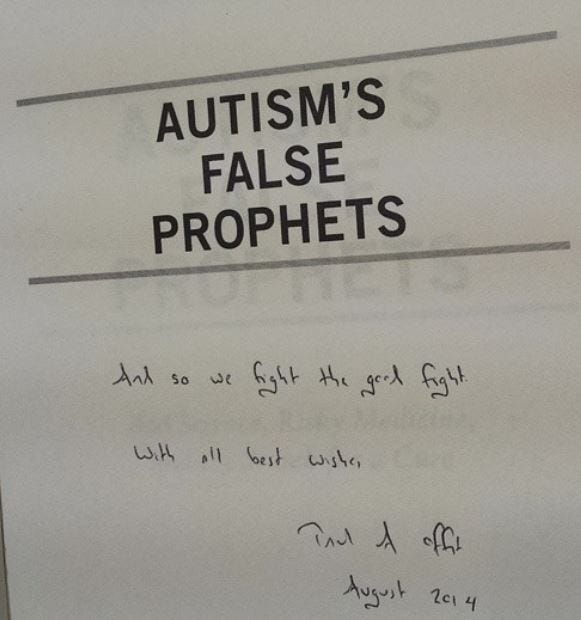
A few months went by and during another argument with my pediatrician, she pleaded with me to read Autism’s False Prophets by Dr. Offit which was just being released.
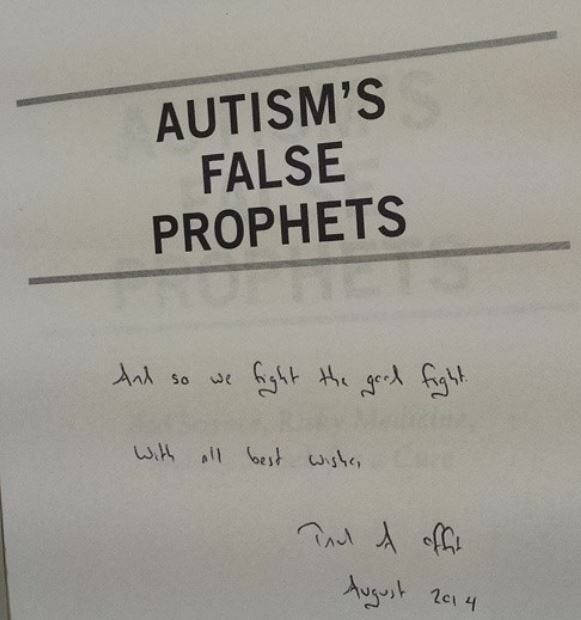
And now my copy is signed…more on that later.
So I did. I don’t know if it was fate, karma or me getting my feet back under me and coming to my senses….but I actually went home, ordered the book, waited a few days for it to arrive, and read it. And once I started, I couldn’t put it down. I felt ashamed, I felt scared (for what I had exposed K to), I felt stupid…I felt relieved.
And then I became angry.
Because here’s the thing….there is no case for not vaccinating your child. Vaccinating has risks, no one has ever claimed that it doesn’t. But the risks of NOT VACCINATING are GREATER than the risks of vaccinating. It’s really that simple. Both have risks, one has a greater risk of harm to children.
So I’m angry for being lied to. Because it is all lies.
As I got my feet under me, I began to embrace my child for who he is, instead of living in fear of who he may become. I felt a life calling to help children with disabilities, and in 20 years I have encountered hundreds of children with various disabilities–including some cancer patients and cancer survivors, children who are medically complex and medically fragile, and some who have other issues that cause them to be immuno-compromised.
So then I get angry all over again. Because these anti-vaxxers are putting those helpless children at risk. A child who is going through chemo, and her parents…they have enough to worry about. They shouldn’t have to worry about some mom passing the flu or chicken pox onto their child because they believe false information. I get really angry when I read things like “I don’t care about herd immunity” because while you may not care, for some children, their lives depend on it. Those are the moms I want to throat-punch. (mostly kidding, I’m not violent at all, but that makes me seethe with anger)
As parents of children with special needs, we are a very vulnerable population. For as much as I love my child and am able to celebrate him for who he is, we still sometimes wish there was a magic pill or potion that could make all of our struggles go away, right? There isn’t, it’s just a daydream. But, for the anti-vaxxers, they usually have an expensive and interesting array of products to go along with your not vaccinating. None of which is proven to work. If they talk you into not vaccinating, that doesn’t bring them any money.
But, if they can sell you the promise of fixing your child with special diets (just buy our book for details!) or supplements (widely available on these sites) or anything else….well it’s quite a lucrative business. This one financial report for the NVIC, just one of many of these organizations, lists that they brought in a million dollars. Where did that money go? How many children did that money help? (answer: 0) Exactly zero lives were made better. They can rant all day long about ulterior motives of doctors, but the anti-vaxxers are making a very nice profit for themselves.
I’m angry that I was lied to and encouraged to put my child at increased risk. He has significant special needs and is non-verbal, a headache or backache from meningitis would be impossible to recognize. He has hypotonia, which means he does not have the muscle tone or strength to produce as forceful of a cough as his peers–something like pertussis or an infection could quickly settle in his lungs and become dangerous. Plus, chromosomally, he is put together differently than you and I…at the most basic DNA level, we don’t even know if his body’s reaction to things like measles and chicken pox will be the same reaction that is seen in other kids. It could be much worse. I still get a feeling of panic and sadness when I think of what could have happened.
That book changed my life. I was so impressed by Dr. Offit’s writings and his commitment to letting people know the science and what is real and true…I wanted to meet him. So one summer I arranged for a few bloggers to tour the Vaccine Education Center. I sometimes wonder, if it hadn’t been for that book, would I have come around? What would have been the catalyst for me to regain my common sense? I don’t know…but I am glad that it happened sooner rather than later.
You know how when people who are former smokers…they become the most ardent supporters for people quitting smoking? It’s like that. I am determined to help my fellow special needs moms not fall victim to this nonsense. Nonsense that is actually becoming dangerous. We are seeing vaccination rates that rival some parts of developing countries in Africa. We are seeing epidemics of measles and whooping cough that we haven’t seen since the 1950s.
All because fear sells.
Now it’s time to fear the diseases again. Vaccine skepticism is a first world luxury. For now, anyway.
So there it is, all out in the open. I think it was easier for me to come to my senses because I am a science person and skeptic anyway. I need to see evidence. I truly feel that there are probably some anti-vaxxers who are in it so deep that they can’t get out, even though in their gut they know that they have been lied to and are lying to others.
It’s very hard to stand up and say “I was wrong” especially when you have put your family in danger, put other children in danger, and have encouraged other moms to do the same. But there is always time to do the right thing. You don’t have to go full force and join Shot at Life and become an advocate like I did.
You can start with one big, meaningful step–take your child to get vaccinated. Get caught up on his/her vaccines, apologize that they have to do so many so late in life. Allow yourself to feel guilty for being misinformed and allow yourself to forgive yourself for that.
You might also be interested in: Grieving Your Child’s Disability Diagnosis: A Controversial Conversation
Recent Entries

Member Statistics
- 2,378 Total Members
- 717 Most Online
-
tawnymaria Newest Member ·
